
On Dailiness
Words as a private space

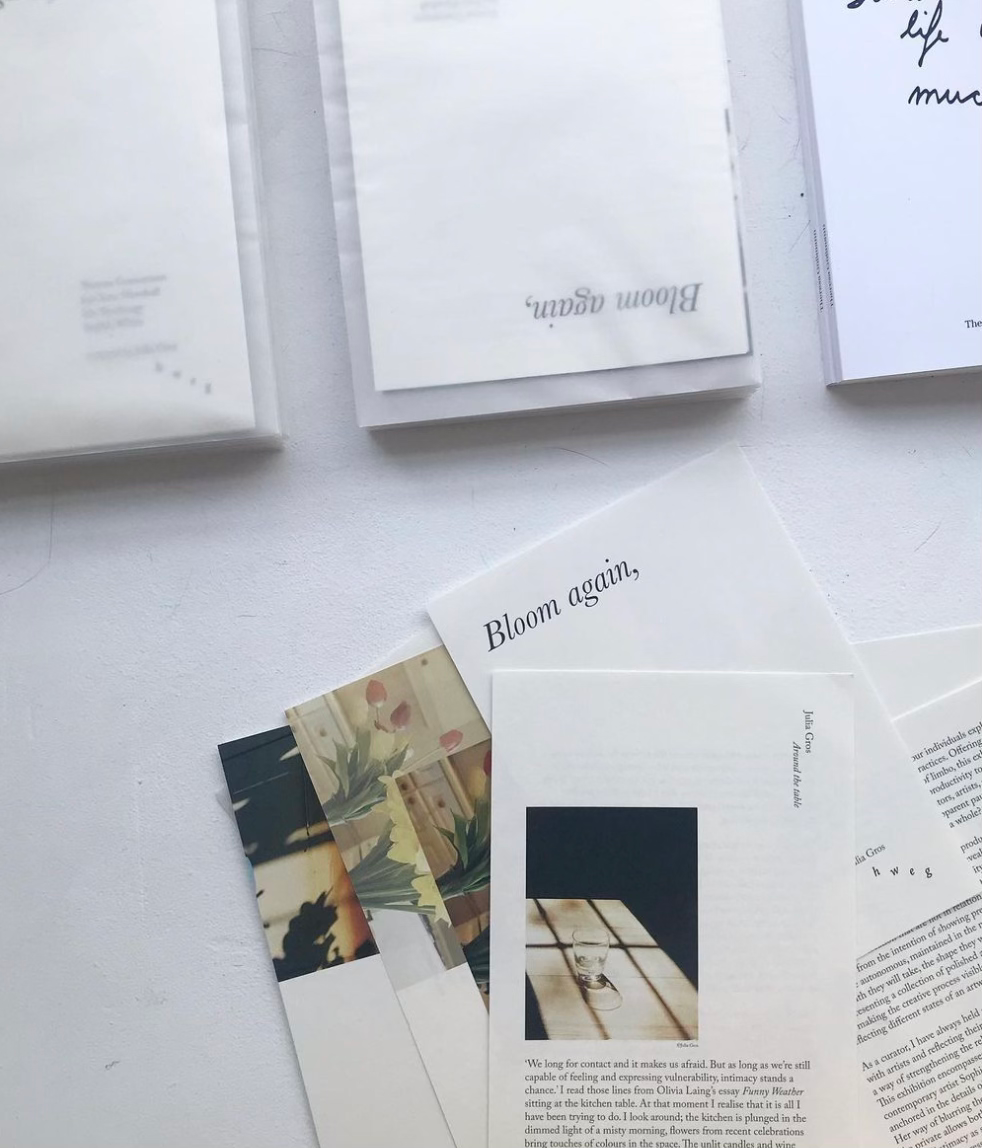
This piece was first published in ‘Bloom again’, an accompanying pamphlet to the exhibition of the same name at Hweg Gallery curated by the brilliant Julia Gros in May 2024.
“In Bloom again, writer Jess Ione Henshall brings a practice of writing based on intimate experiences of life and observations of small moments. By deepening into daily life and her living environment, she finds answers to embrace moments of pause and transition. The art of noticing reveals a strong understating of the power of words to keep active what she calls her ‘creative muscle’. Moving away from the pressure and expectations of ‘being inspired’ as a transcending act but digging out from the ground of the existing, she offers a personal, yet universal perspective on a sensitive world.” — Julia Gros
This writing begins with an uneasiness; the desire to remove the self from its own story. These words sit somewhere within an idea that introspection of the first person is earned over time, and as of yet, I have not lived enough. And so this writing begins in contradiction because I cannot remove myself from my own story, in the same way I cannot remove myself from my body. In this case, they are one and the same.
*
Of all the seasons, the listless ones stretch the longest. Even in my small years, I have lived in limbo, felt days upend into each other as my body or what I thought I knew of my life moved into new and uncertain states. When the more explicit definers of life – friends, loves, plans, health – drop away and we are left in the sticky stuff of the self, how do we feel that we are living and not just passing through our days?
On a weekend away with friends, we move between galleries and eateries, in one hour visiting two converted chapels now housing art and food. It occurs to me how a place can change its form yet still retain its original thought — art and food are their own kind of worship, words too. Many of us begin a relationship with words in the space of a notebook, the form changing between childhood and adulthood from dear diary dreaming to the recording of a life. In this way, it remains a private space, a sort of self-communion.
When I am writing, I feel I am living. The opposite is also true; when I am not writing, I feel I am not living. To my own self-detriment, I am often not writing — I have trouble staying with myself, more so in times of quiet when there are less visible contexts of who I am. Notebooks are some epitome of this, the desire to begin again, blank slate, blank space, a rewriting of the self in present tense.
Over many years, I have kept many diaries but never to their completion, quickly dismissing their words as either too banal or too emotive of what I was experiencing during those times. Those two extremes are where I have often found myself, reckoning with words written weeks or minutes ago. When I write in a notebook, I do so without the intention of returning to its pages, forever worrying I will have outgrown my words by the time they come to represent me in the world. I have a habit of recycling every notebook I have written in.
Not writing, or writing but discarding: habits form, they stick. So much is lost in that process. I leave myself without an outline, nothing to hold the details of my own life, and my capacity for that kind of self-erasure haunts me.
When I am writing, I am calling back to those whose works came from that space of dailiness. There’s a commonality in the books I gravitate towards these days, a litany of women who did not hide in the face of their own limbo, who instead ground into it, drawing out some kind of universal truth in the process. I find much of myself in these words; I fold into them the way I fold into my own, full-bodied, searching.
If writing is a means for paying attention, the notebook is a space for dailiness in its most allowing form. Small observations – grounded in what remains after indistinct losses leave us with the matter of ourselves – are a map in how to move away from the pressures of living enough, towards a space where a focus on the quiet and mundane can offer a way to stay with ourselves when it seems impossible.
Lately, the tangibility of what I have looked to in my own world has shifted, and each time I have returned to the pages of recent notebooks (unusually still intact), I have been met with surprise in how these words still resonate in the way they ground into daily matter and move beyond the surface of a scene to evoke the other senses — how I felt in that moment, who I was, who I was becoming. These re-readings are a reclamation. Through the tender space of the notebook, I place these years in parenthesis; permission given to skim over, or an invitation to return.
You’ve touched my heart with your words Jess 🤍 Such wonderful reminder of how the act of noticing, of sitting with the quiet and the overlooked, can become its own kind of survival. In a world so preoccupied with doing and achieving, there’s something profoundly freeing about letting the mundane hold us, allowing it to be enough. Thank you for sharing.